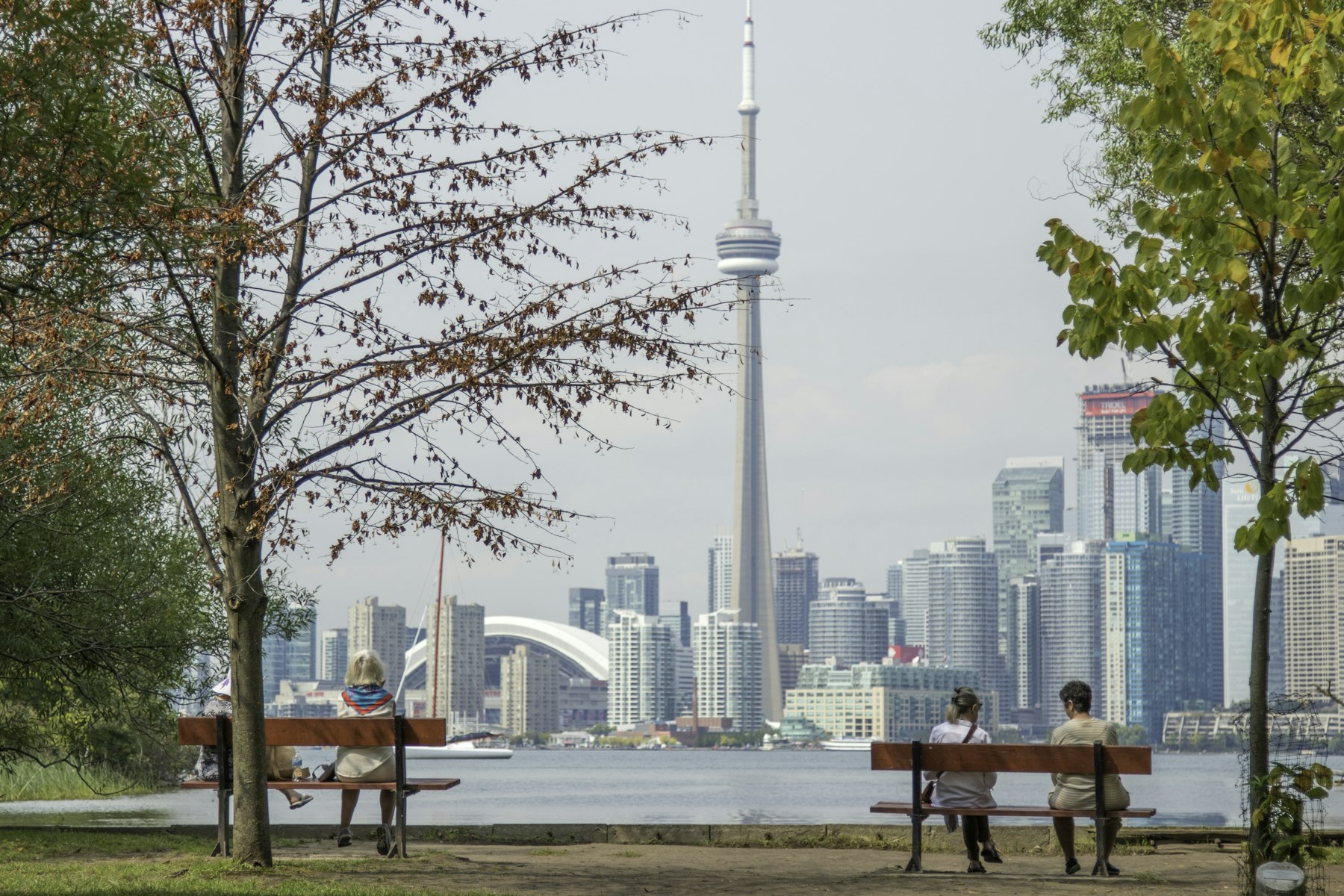
Ontario is the easiest province to underestimate, partly because so much of its story is the country's story. The federal government sits here. The largest banks, the largest stock exchange, the largest city, the busiest port and the busiest airport are all here. Most of Canada's films, television and English-language publishing are produced here. For a certain kind of visitor — the one who flies into Toronto, takes a train to Ottawa and leaves — it's possible to think you've seen Canada when you've really only seen the southern tenth of one province.
- Capital
- Toronto
- Population
- ~15.9 million
- Joined Confederation
- 1867 (founding)
- Languages
- English (majority), French (official-services province-wide)
- Time Zones
- Eastern (most of province); Central (far northwest)
- Sales Tax
- 13% HST
- Drinking Age
- 19
- Land Area
- 1,076,395 km² (larger than France & Spain combined)
A wide-angle overview
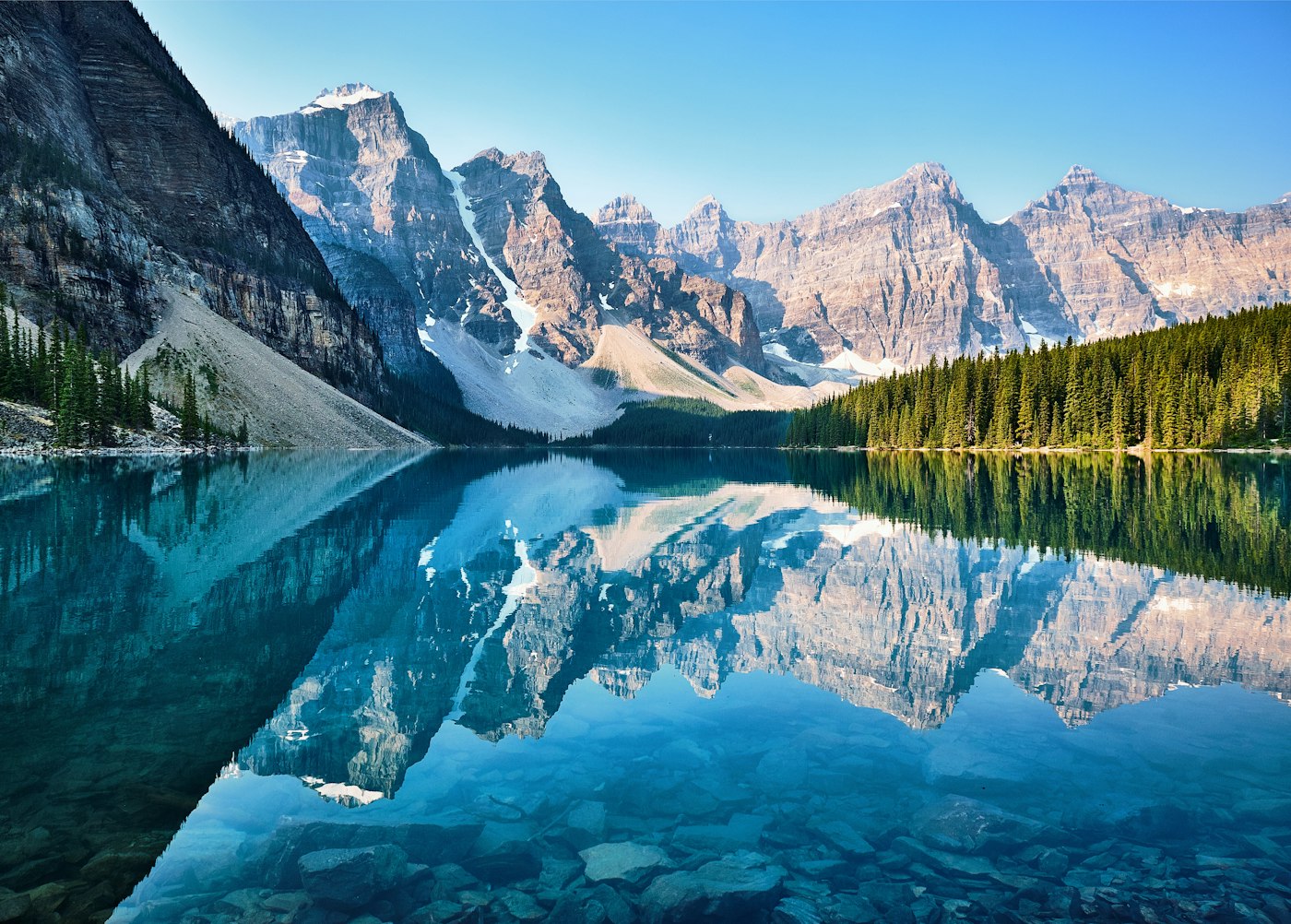
You can happily spend a month in Ontario without running out of things to do. The province is enormous — bigger than France and Spain combined, fully one-tenth the size of the European Union, and stretching some 1,690 km from Pelee Island in the south to Fort Severn on Hudson Bay in the north. The geography is the reason Ontario has never quite felt like one place to the people who live in it. South of Highway 7 you find the lakes-and-farmland Ontario most foreigners picture: Lake Erie, Lake Ontario, the Bruce Peninsula, Niagara wine country, the Greenbelt around Toronto, and a long deciduous forest that turns gold and orange in October. North of there the Canadian Shield takes over — granite, jack pine, blueberries and an inexhaustible supply of lakes — and eventually surrenders to the boreal forest and finally to the treeless Hudson Bay Lowlands.
Ontario produces about 38 percent of Canada's GDP. The economy used to be almost entirely industrial: steel in Hamilton, autos in Windsor and Oshawa, agricultural processing across the south. That base has shrunk over the last thirty years but it has not disappeared, and it has been overlaid with a financial sector centred on Bay Street, a research-heavy university and hospital system, a film and television industry that uses Toronto as a stand-in for Chicago and New York, and a tech belt running from Waterloo through Mississauga into Toronto's downtown.
Politically, Ontario has been the swing province in Canadian federal elections for decades. Its provincial parliament, called Queen's Park, sits in downtown Toronto. The current Progressive Conservative government under Doug Ford has held office since 2018 and was re-elected in 2022 and again, on a smaller margin, in early 2025; the New Democratic Party and the Ontario Liberals are the principal opposition. Ontario's politics tend to be less ideological than its neighbours' — it is a province that elects centrist governments of either stripe and replaces them when their welcome wears out.
Demographically, Ontario is the most diverse province in Canada by a wide margin. Over half of the population of Toronto, Mississauga, Brampton and Markham was born outside Canada. Roughly 5 percent of the province speaks French at home, concentrated in eastern Ontario (Ottawa, Cornwall, Hawkesbury) and the northeast (Sudbury, Timmins). There are 134 First Nations in the province, and Indigenous communities are a significant share of the population in the north.
A compact history
The land that is now Ontario was home to the Anishinaabe (Ojibwe and Mississauga), the Haudenosaunee (Iroquois Confederacy), the Wendat (Huron) and the Cree long before Europeans arrived. French coureurs des bois, Jesuits and traders began moving through the region in the early 1600s; the mission village of Sainte-Marie among the Hurons, near what is now Midland, was founded in 1639 and abandoned a decade later after a devastating Iroquois raid. The fur trade rerouted the area's economy for the next 150 years.
After Britain took the territory from France in 1763 and again after the American Revolution sent tens of thousands of Loyalists fleeing north, the colony of Upper Canada was carved out in 1791. Its capital was first Newark (now Niagara-on-the-Lake) and then York, which a fire in 1813 partly burned and which was renamed Toronto in 1834. The War of 1812 was fought across the south of the colony; the burning of York was the act that loosely justified the burning of Washington in retaliation a year later.
The Rebellion of 1837 against the colonial elite, the union of the Canadas in 1841, and finally Confederation in 1867 produced the province as we have it now. The next century built the industrial base — railways through the Shield, hydroelectric dams on the Niagara River, the steel mills of Hamilton, the auto plants of Oshawa and Windsor — and pulled large rural populations into the cities. Postwar immigration from Italy, Portugal, the Caribbean, Hong Kong, South Asia, Eastern Europe and (more recently) the Philippines, Nigeria, India and Iran rebuilt Toronto and the cities around it into something that does not look much like the Ontario of 1950.
The deindustrialisation of the 1990s and 2000s hit the province's manufacturing belt hard. Cities like Windsor, St. Thomas and Welland have only recently begun to recover. The Greater Toronto Area, by contrast, kept growing through every recession of the last forty years and now adds more population each year than every Atlantic province combined.
Toronto
- Metro population
- ~6.7 million
- Foreign-born
- ~50% (highest of any major OECD city)
- Best months to visit
- Late May – early October
- Average 1-bed rent (2026)
- CAD $2,300 – $2,800 downtown
Toronto is Canada's largest city, the capital of Ontario, and by most measures the fourth-largest metropolitan area in North America after Mexico City, New York and Los Angeles. About 6.7 million people live in the Greater Toronto Area. More than half were born outside Canada, which makes Toronto one of the most foreign-born cities in the world — ahead of London, New York and Sydney by a margin that surprises people. The city's identity is built on that fact rather than around it. Walking from Bloor Street north to Eglinton on a Saturday morning you will pass through Korean, Greek, Italian, Iranian and Filipino main streets without ever leaving residential Toronto.
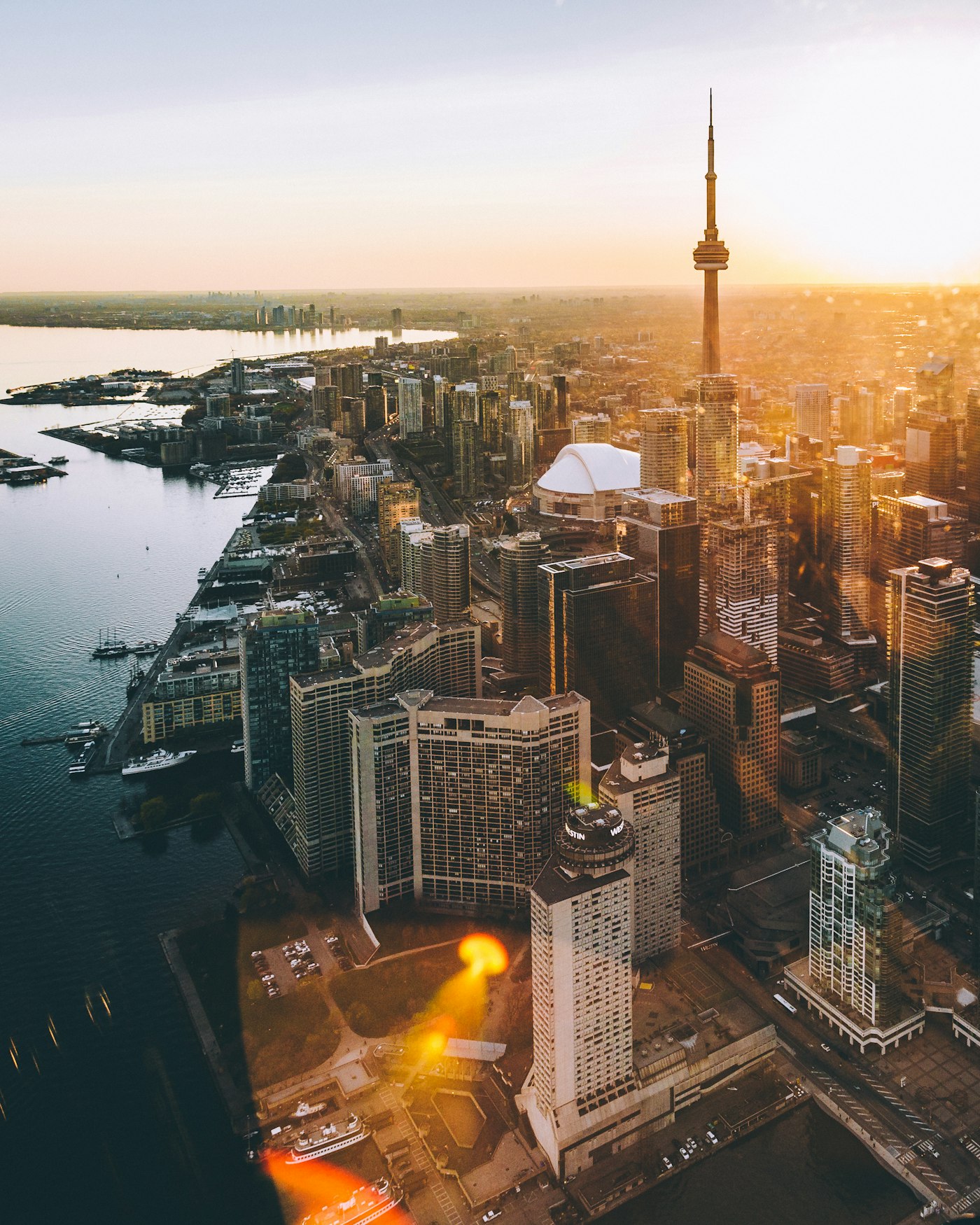
The downtown core sits between Bloor Street in the north and Lake Ontario in the south, and between roughly Bathurst Street in the west and the Don River in the east. Inside that box you'll find the Financial District (office towers, the underground PATH walkway, the big banks), the Entertainment District (theatres, bars, the CN Tower, the Rogers Centre), Chinatown (still very active on Spadina), Kensington Market (the scruffy, affectionate heart of the city), and the Distillery District (cobblestoned and very photogenic, if a bit packaged).
Outside the core the character changes quickly. The Annex is old academic Toronto, all red-brick houses and second-hand bookstores. Leslieville and Riverside are the east end's coffee-and-stroller belt. Little Italy on College Street has not been predominantly Italian for thirty years but it is still where to go for an espresso at midnight. Parkdale is where to go for Tibetan food. The Beaches (or "the Beach," depending on who you ask) is a lakefront neighbourhood with a boardwalk that feels almost like a small town. Scarborough and North York, outside downtown, are where the city's true food culture lives — Korean in North York, Sri Lankan and Chinese in Scarborough, South Asian along Gerrard East.
Post-secondary education in Toronto
The University of Toronto is the dominant institution, with around 97,000 students across three campuses (St. George downtown, Scarborough, and Mississauga). It is the highest-ranked Canadian university by almost every international measure and it operates in close partnership with the city's hospital network on University Avenue, which is one of the densest concentrations of biomedical research in North America. Toronto Metropolitan University (formerly Ryerson, renamed in 2022) sits beside the Eaton Centre and has a strong journalism, engineering and business profile. York University, in the northwest of the city, is the country's third-largest university, with the Schulich School of Business and Osgoode Hall Law School. OCAD University, the country's oldest art and design school, occupies the building with the legs on Dundas Street West.
Tuition for domestic Ontario students at U of T runs roughly CAD $7,000–$15,000 per year depending on program; international tuition is several times that, often $50,000–$70,000 for engineering or business. Add roughly $20,000–$28,000 for living costs in the city. The financial aid offices are useful and the OSAP provincial loan program is the standard tool for domestic students. Acceptance to U of T's competitive faculties — engineering, computer science, the Rotman commerce program — is genuinely difficult, with high-90s averages required from Ontario high schools.
Housing & cost of living in Toronto
Painfully expensive, in short. As of early 2026 a one-bedroom apartment rents for roughly CAD $2,300 to $2,800 per month in the downtown core; closer to $1,900 to $2,200 in the inner suburbs (Scarborough, North York, Etobicoke); and $1,600 to $1,900 in the outer suburbs along the GO Train lines. The benchmark price for a detached house inside the old city limits is well over CAD $1.5 million; condo prices have softened from the 2022 peak but a downtown one-bedroom condo still asks roughly $650,000 to $800,000.
Groceries and restaurants are in line with other large North American cities, but everything carries 13 percent HST, which is a surprise if you have arrived from Alberta or from a U.S. state with no sales tax. A weekly grocery bill for two people runs roughly $150–$220 if you shop carefully at No Frills or FreshCo and rises sharply if you default to Loblaws or Whole Foods. Transit is a $3.35 fare or $156 monthly pass on the TTC. Hydro (electricity) and natural gas together usually run $90–$180 a month for a one-bedroom. Internet from one of the big providers is $80–$110, though smaller resellers like Beanfield, TekSavvy and Carry can save you a third of that.
The practical upshot is that a single person in Toronto needs roughly CAD $55,000–$70,000 after tax to live comfortably without a car; a family of four in a three-bedroom anywhere within the old city limits is looking at $130,000+ after tax just to keep its head above water. Wages have risen but not as fast as rent, which is the underlying reason Toronto's politics have become more focused on housing than anything else over the past decade.
Cultural scene, food & tourist attractions
The CN Tower was the world's tallest free-standing structure from 1975 until the Burj Khalifa overtook it in 2007. It still defines the skyline. The observation deck is honestly worth the money on a clear day — you can see the spray of Niagara Falls on the horizon — and the glass floor is more convincing than you expect. Book online in advance on summer weekends. The Rogers Centre next door is home to the Toronto Blue Jays and, before that, was a regular setting for the SkyDome roof to fail spectacularly in the 1990s.
The Royal Ontario Museum on Bloor Street is the country's largest museum and has a strong dinosaur and East Asian collection. The Art Gallery of Ontario, redesigned by Frank Gehry in 2008, is the major fine-art museum and is unmissable for the Group of Seven and Inuit galleries. Casa Loma, a Gothic Revival mansion on the escarpment above the Annex, is the city's most photographed building after the CN Tower.
For food, Toronto's strengths are in the immigrant neighbourhoods rather than the downtown chef-driven scene. The best meals in the city are usually under $25 a head: a roti at Vena's Roti House on Eglinton, a banh mi on Spadina, the karaage on Yonge Street north of the 401, the Sri Lankan rice and curry on Pharmacy Avenue, the Ethiopian on the Danforth's east end. The festival calendar fills the summer — Pride at the end of June (one of the largest in the world), the Caribbean Carnival in early August, Taste of the Danforth in mid-August, and the Toronto International Film Festival across the second weekend of September, which is the only time of year the entire downtown core is given over to a single event.
Sports & recreation
Toronto is the only Canadian city with a team in all four major North American leagues plus the WNBA. The Toronto Maple Leafs (NHL) play at Scotiabank Arena and have not won a Stanley Cup since 1967, which is a recurring topic of conversation. The Toronto Raptors (NBA) won the championship in 2019 and have made the playoffs almost every year since. The Toronto Blue Jays (MLB) won back-to-back World Series in 1992 and 1993 and have been variously competitive since. Toronto FC (MLS) won the league in 2017. The Toronto Argonauts (CFL) play at BMO Field. The Toronto Tempo, the WNBA expansion franchise, begins play in 2026 at Coca-Cola Coliseum.
Outside professional sport, the city's recreational geography is shaped by its ravines — a network of forested river valleys that runs through the middle of Toronto and contains roughly 11,000 hectares of trails. The Don Valley, the Humber, Taylor-Massey Creek and the lakeshore Martin Goodman Trail are all accessible by bike from downtown. In winter, the Bentway under the Gardiner Expressway has a free outdoor skating loop, and Nathan Phillips Square in front of City Hall has the postcard ice rink. Skiing is at Blue Mountain near Collingwood, two hours north.
The honest take
Toronto is one of the great immigrant cities of the world, and it is also a city that has spent the last fifteen years pricing out the people who built it. The transit system is overstretched. The rental market is unforgiving. The downtown is more visibly troubled by drug poisoning and homelessness than it was a decade ago. None of that erases the case for being here — the food, the universities, the job market, and the deep, quiet pleasure of a city where everyone is from somewhere else — but you should arrive with eyes open and a plan for housing.
Ottawa
- Metro population
- ~1.55 million (with Gatineau)
- Languages
- English & French (effectively bilingual)
- Average 1-bed rent (2026)
- CAD $1,750 – $2,100
- Best season
- Late spring through autumn; February for Winterlude
Ottawa is Canada's capital, a city of about 1.1 million on the Ontario side of the Ottawa River, which here forms the border with Quebec. Across the river, on the Quebec side, is the city of Gatineau; together they form the National Capital Region, with around 1.55 million residents. It is a smaller, calmer, more bureaucratic city than Toronto, with longer winters and a much greener summer. The federal government is the dominant employer; the tech corridor in Kanata, the universities (Carleton, Ottawa, Saint Paul) and the hospitals make up most of the rest.
Queen Victoria chose Ottawa as the capital in 1857, largely as a compromise. It sat on the border between English-speaking Upper Canada and French-speaking Lower Canada; it was further from the American border than Toronto, Montreal or Kingston; and it was not any of the cities that had been lobbying for the role, which annoyed everyone equally. The choice was unpopular at the time but has worn well.
The shape of the city follows the river. Parliament Hill sits on a bluff in the centre, with the Gothic Revival Parliament buildings looking out across the water to the Quebec side. The Rideau Canal — a UNESCO World Heritage site — cuts down through downtown to the Ottawa River, and in winter its seven-kilometre downtown stretch becomes the world's largest naturally frozen skating rink, the Rideau Canal Skateway. In summer the same path becomes the city's main pedestrian-and-cycle artery.
Post-secondary education in Ottawa
The University of Ottawa, in the city's downtown, is one of the largest bilingual universities in the world — you can complete almost any degree in either French or English. It has Canada's largest law school and is the country's leading research institution in health and biomedical sciences when measured by federal funding per faculty member. Carleton University, just south of downtown by the Rideau Canal, is the city's other major university and has a particular strength in journalism, public affairs, and aerospace engineering. Algonquin College in the west end is the largest college in eastern Ontario, with strong applied programs in IT, hospitality, the trades, and animation.
Tuition is comparable to other Ontario universities (roughly $7,500–$13,000 per year for domestic students). The cost of student living — rent, food, transit — runs roughly 20 percent below Toronto, which is a large part of why both Ottawa universities are popular with out-of-province students.
Housing & cost of living in Ottawa
Ottawa is not cheap, but it is meaningfully more affordable than Toronto. A one-bedroom downtown rents for roughly CAD $1,750–$2,100 per month; in inner neighbourhoods like Hintonburg, Westboro or Vanier you can sometimes find them for $1,550–$1,750. The benchmark price for a single-family home inside the Greenbelt is around $700,000–$850,000, less than half of Toronto. Property taxes are higher than Toronto's as a percentage of value, which surprises buyers from out of province.
Salaries in the federal public service are set on a national scale, which means Ottawa is one of the better cities in Canada to be a mid-career federal employee — the salary is the same as in Toronto or Vancouver but the cost of living is markedly lower. Tech salaries in Kanata have caught up with Toronto in the last few years and continue to rise. Healthcare wages are negotiated provincially and are in line with the rest of Ontario.
Cultural scene, food & tourist attractions
Parliament Hill is the obvious draw. The Centre Block is closed for a decade-long restoration that began in 2019 and is now expected to wrap around 2031, but the West and East Blocks are open for free guided tours if you book ahead through the Visitor Welcome Centre. The Changing of the Guard happens daily on the front lawn from late June through late August at 10 a.m.
Beyond Parliament, Ottawa has a remarkable concentration of national museums for a city its size. The Canadian Museum of History (across the river in Gatineau, with one of the most important Indigenous art galleries in the country), the National Gallery of Canada (the big glass building behind the giant Maman spider sculpture), the Canadian War Museum, the Canada Aviation and Space Museum, and the Canadian Museum of Nature each easily fill a half-day. The annual Tulip Festival in mid-May, a gift from the Dutch royal family in thanks for Canada's role liberating the Netherlands, fills Commissioners Park with around a million bulbs.
The food scene is younger than the city's reputation suggests. Hintonburg and Wellington West have become Ottawa's restaurant rows; Beckta, Riviera, and the Atelier tasting menu represent the high end, while shawarma in Centretown and the Vietnamese in Chinatown represent the everyday. Beavertails, the deep-fried pastry, was invented in Killaloe near here and is a fixture along the canal in winter.
Sports & recreation
The Ottawa Senators (NHL) play at the Canadian Tire Centre in Kanata; ownership changes in 2023 have prompted serious discussion of an eventual downtown arena, possibly at LeBreton Flats. The Ottawa Redblacks (CFL) play at TD Place in the Glebe and won the Grey Cup in 2016. The Ottawa Charge of the PWHL (Professional Women's Hockey League) play at TD Place's arena and have been a quiet success since the league's launch in 2024.
Recreationally, Ottawa is one of the best cycling cities in North America. The pathway network along the Ottawa River, the Rideau Canal and the Rideau River is over 600 kilometres of largely off-road, paved trails. Sundays from May to October the city closes its parkways to cars for "Bikedays." Gatineau Park, fifteen minutes from downtown across the river, has 50 km of cross-country ski trails in winter and excellent hiking and lake-swimming in summer.
The honest take
Ottawa has a reputation as a quiet city, and the reputation is half-earned. It will not match Montreal for nightlife or Toronto for restaurants. What it offers, increasingly, is a workable middle-class life: a 25-minute commute, an affordable house, a 600-kilometre cycle network, two strong universities, and a federal job market that pays a national wage. For families and for mid-career professionals it is one of the best deals in Canada.
Hamilton
- Metro population
- ~785,000
- Distance from Toronto
- ~70 km west
- Average 1-bed rent (2026)
- CAD $1,500 – $1,800
- Big employer
- Hamilton Health Sciences (~17,000 staff)
Hamilton sits at the western tip of Lake Ontario, about 70 kilometres from Toronto along the QEW. It used to be called Steeltown — the steel industry, centred on the descendants of Stelco and Dofasco, still operates and still employs several thousand people, but it is no longer the city's defining sector. Healthcare, anchored by Hamilton Health Sciences and St. Joseph's, is now the largest employer, followed by McMaster University and a fast-growing professional and creative sector that is partly the result of Toronto cost-pushed migration.
Hamilton has been having a slow renaissance since the mid-2010s. Rents are still cheaper than Toronto, a lot of Toronto artists have moved here, and the downtown streets along James North and King William have an energy that the city did not have twenty years ago. There are more than a hundred waterfalls on the Niagara Escarpment inside the city limits — Hamilton is sometimes called the Waterfall Capital of the World — and the Bruce Trail, Canada's oldest long-distance footpath, runs along the Escarpment through the middle of the city.
The city's geography is split between the "lower city" along the harbour and the "mountain" above the escarpment. Most of Hamilton's classic neighbourhoods — Westdale near the university, Locke Street, Stinson, Strathcona, the North End — are in the lower city. The mountain is more suburban and was largely built between 1955 and 1985. The two are connected by escarpment access roads that locals refer to by name.
Post-secondary education in Hamilton
McMaster University, in the city's west end, is the academic anchor. Its medical school, founded in 1965, pioneered the case-based curriculum that has since been adopted by medical schools around the world. The DeGroote School of Business, the engineering faculty (which has a particularly strong reputation in materials and biomedical engineering) and the nuclear research reactor on campus — one of only two operating university research reactors in Canada — are the other major draws. Total enrolment is about 38,000 students. Mohawk College, with two campuses in the city, is the major polytechnic and a national leader in apprenticeship training.
Housing & cost of living in Hamilton
Hamilton is no longer the bargain it was in 2015, but it remains substantially cheaper than Toronto. A one-bedroom apartment rents for roughly CAD $1,500–$1,800 in 2026; the benchmark price for a detached home in the lower city is around $750,000, perhaps $850,000 on the mountain. The cost-of-living gap with Toronto is large enough that Hamilton has, since the pandemic-era shift to hybrid work, become a viable commuter city for people whose jobs only require them downtown twice a week — the GO Train from Hamilton's West Harbour and Confederation stations runs to Union Station in roughly 65 minutes.
Cultural scene, food & tourist attractions
Walk the Dundas Peak lookout for a view over Spencer Gorge in autumn (book a parking pass in advance — it is the most popular short hike in the province). Eat along James Street North, which hosts an art crawl on the second Friday of every month. Visit the Art Gallery of Hamilton, which has a better permanent collection than the city's reputation suggests. The Royal Botanical Gardens, straddling the Hamilton-Burlington line, is the largest in Canada by land area. If industrial landscapes appeal, the Burlington Skyway at sunset gives you the cinematic version of the steel mills against the water.
The food scene has shifted in the last decade. Earth to Table Bread Bar, the various restaurants in the Locke Street strip, and a long list of Vietnamese, Caribbean and Portuguese spots in Crown Point and Stipley make Hamilton a credible eating city for a place its size.
Sports & recreation
The Hamilton Tiger-Cats (CFL) play at Hamilton Stadium, which hosted the 2015 Pan American Games soccer matches. The Forge FC of the Canadian Premier League, founded in 2019, has been the dominant team in the league since its inaugural season. Beyond professional sport, the city's recreational identity is built on the Bruce Trail, the cycling along the waterfront, and the swimming holes (Webster's Falls, Tiffany Falls) tucked into the escarpment.
The honest take
Hamilton in 2026 is the city Toronto might have been if it had stayed about a third its current size. It still has visible poverty, a shrinking but real industrial base, and a downtown that has not finished its renaissance. It also has the best escarpment views in southern Ontario, a top-15 university, and a one-bedroom apartment for a third less than Toronto. For a couple in their thirties priced out of the GTA, Hamilton has been the answer for ten years and continues to be.
London

- Metro population
- ~550,000
- Distance from Toronto
- ~190 km on Highway 401
- Average 1-bed rent (2026)
- CAD $1,450 – $1,750
- Anchor employer
- Western University & London Health Sciences Centre
London, Ontario sits roughly halfway between Toronto and Detroit on Highway 401. About 550,000 people live in the metropolitan area. It was named in 1793 by John Graves Simcoe, who wanted it to be the capital of Upper Canada on a Thames River of his own — the Thames does run through downtown, there is a Covent Garden Market, and neighbourhoods are called things like Blackfriars and Old North. York (now Toronto) ended up with the capital instead, but the borrowed names stayed.
It's an insurance town and a medical-research town. Three large insurance companies are headquartered here, the hospitals are the largest single employer, and Western University, in the city's north end, is the dominant cultural and economic force. London is also a quietly good live-music city — Guy Lombardo was born here, and so were a long list of more recent rock acts including the Killjoys, Alanis Morissette (who grew up in nearby Ottawa but recorded her first records here) and the post-rock band Do Make Say Think. The London Music Hall and the Aeolian Hall both punch above their weight on the touring circuit.
The downtown is currently in the middle of a long, halting recovery. Dundas Place, redesigned as a flexible-street pedestrian zone in 2019, has filled in with restaurants and small bars, and the Covent Garden Market remains a popular gathering point. The waterfront along the Thames Valley Parkway, a 40-kilometre paved cycle and walking trail, is the city's strongest recreational asset.
Post-secondary education in London
Western University is the second-largest university in Ontario by enrolment after Toronto, with around 39,000 students. The Ivey Business School is the country's flagship case-method MBA program; the Schulich School of Medicine & Dentistry is a respected research medical school; the engineering faculty has had a strong international student draw for two decades. Tuition for domestic students is in line with Ontario averages (around $7,000–$13,000 a year); residence and meal plans run about $14,000–$17,000.
King's, Huron and Brescia — three affiliated colleges — offer smaller-class alternatives within the Western system. Fanshawe College, with roughly 21,000 full-time students across multiple campuses, is the city's polytechnic and a major source of skilled trades graduates for southwestern Ontario.
Housing & cost of living in London
London is one of the more affordable larger cities in Ontario. A one-bedroom rents for roughly CAD $1,450–$1,750. A detached home in a desirable older neighbourhood like Old North or Old South lists at around $650,000–$900,000; comparable houses in newer subdivisions in the north end and the east go for $550,000–$750,000. A trade-off is that London's rental supply runs heavily towards student-oriented housing, which means non-students often find the available options dated.
Cultural scene, food & tourist attractions
The Thames Valley Parkway is the main draw for casual visitors — 40 km of paved trail along the river, threading the parks system from south London up to the university. Fanshawe Pioneer Village, in the city's east, is a 33-building open-air museum of 19th-century Ontario life. Museum London on the river has the city's best collection of Canadian art. For day trips, the Stratford Festival (one of the largest classical theatre festivals in North America) is 50 minutes north on Highway 7, and the long Lake Erie shoreline at Port Stanley is 35 minutes south.
Food is good rather than world-class. The Idlewyld Inn, the various restaurants in the Wortley Village strip, and a handful of well-run South Asian, Vietnamese and Salvadoran kitchens in the city's east end are the main reasons local food writers stay busy.
Sports & recreation
The London Knights of the OHL are the city's central sporting institution — a Memorial Cup-winning junior hockey team that has produced an unusual number of NHL stars (Patrick Kane, Mitch Marner, John Tavares all spent time at Budweiser Gardens). The arena downtown is one of the busiest in the OHL by attendance. London also has a Frontier League baseball team (the London Majors), a National League rugby club, and a thriving golf scene that benefits from a long growing season relative to the rest of southern Ontario.
The honest take
London is the kind of city that gets described as "underrated" so often it has stopped being underrated. It will not deliver the cultural intensity of Toronto, but it offers a credible mid-sized-city life: a top-tier university, a decent food scene, a long river trail, hospital-anchored job stability and housing prices that make sense. For Western alumni who never quite left, and for relocating professionals from larger Canadian cities, it works.
Niagara Falls & Niagara-on-the-Lake
- Niagara Falls (city) population
- ~94,000
- Falls drop (Horseshoe)
- ~57 metres
- Wineries in the region
- ~100+
- Distance from Toronto
- ~130 km (90 minutes by car)
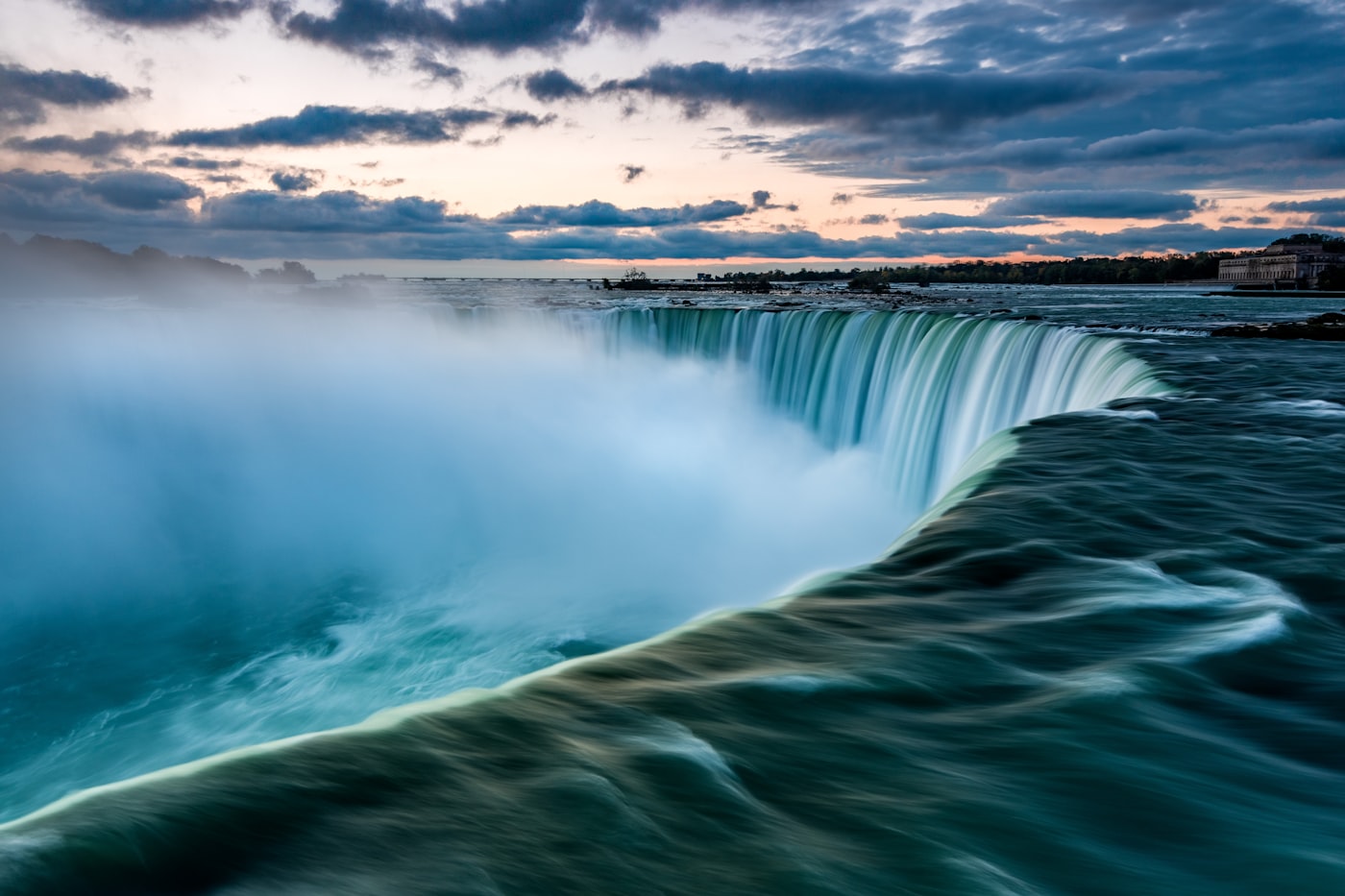
The town of Niagara Falls, on the Canadian side, is built around the view. The Horseshoe Falls — the big curved one on the Canadian side — drops about 57 metres and carries roughly 2,400 cubic metres of water per second during the summer tourist season. The American Falls is smaller, straighter, and (most Canadians will tell you) less impressive from any angle. Together they pour water from four of the five Great Lakes towards the fifth, Lake Ontario.
The Canadian side gets the frontal view of both falls; the American side gets the top of its own. Where the Canadian side lets itself down is the strip of wax museums, haunted houses and themed restaurants on Clifton Hill just above the falls, which feels like an outlet mall for kitsch. Walk past it and hug the riverside Niagara Parkway instead — Sir Winston Churchill's "prettiest Sunday afternoon drive in the world" remains accurate, particularly between Niagara Falls and Niagara-on-the-Lake.
Most visitors do Niagara Falls as a day trip from Toronto (about 90 minutes by car, or two hours by GO Train plus a connecting WEGO bus from the station). That is enough to see the falls, ride the Niagara City Cruises boat (formerly Maid of the Mist) into the spray, walk the Journey Behind the Falls tunnels, and have lunch. If you want a proper weekend, drive 25 minutes north to Niagara-on-the-Lake, a beautifully preserved 19th-century town of about 19,000 people with the Shaw Festival theatre, dozens of wineries, and a waterfront that looks out across Lake Ontario to Toronto on a clear day.
Post-secondary education in the Niagara region
Brock University, in St. Catharines, is the region's main university. Its Goodman School of Business and the cool-climate oenology and viticulture program are the standouts — the latter is probably the best wine-science degree in Canada and supplies a substantial share of the region's working winemakers. Niagara College has a winery and a brewery on its Niagara-on-the-Lake campus, both run as teaching operations and both producing genuinely good wine and beer that you can buy at the campus shop.
Housing & cost of living in the Niagara region
Niagara has been one of the more aggressively heated housing markets in southern Ontario in the 2020s, partly because of its proximity to Toronto and partly because retirees from across Ontario have been moving here. A one-bedroom in St. Catharines or Niagara Falls rents for roughly CAD $1,400–$1,750 in 2026; in Niagara-on-the-Lake itself the rental market is small and expensive (often $2,200+ for a one-bedroom). House prices in the wine-country villages are well above what you might expect for the size of town: a heritage cottage in NOTL frequently exceeds $1.2 million.
Cultural scene, food & tourist attractions
Niagara is Canada's most important wine region after the Okanagan and produces almost all of the country's icewine. The wineries cluster in three sub-regions: the Niagara-on-the-Lake bench (Inniskillin, Peller, Stratus, Trius), the Twenty Valley near Vineland (Tawse, Cave Spring, Henry of Pelham), and the Beamsville Bench (Malivoire, Hidden Bench, Thirty Bench). A guided wine tour leaves from most Niagara hotels in season; a designated driver of your own is the better option if you want to set the pace. The Shaw Festival in NOTL runs from April through October and stages roughly 12 productions a season at three theatres.
The Niagara Glen, a forested gorge below the Whirlpool Rapids, is a hidden secret — a 90-minute hiking loop with class-V whitewater roaring through it that almost no tourists ever find. The Bruce Trail, which finishes at Queenston Heights, gives you a 25-km headwall above the Niagara River from there north.
Sports & recreation
Recreation here is mostly cycling and hiking. The 56-km paved Niagara River Recreation Trail runs from Fort Erie to Niagara-on-the-Lake along the river and is one of the prettiest rides in the country. The Niagara IceDogs of the OHL, in St. Catharines, are the region's main spectator sport; the Toronto Blue Jays' Class A affiliate played here for years before relocating, and a new affiliated team is rumoured for 2027.
The honest take
Niagara Falls itself is a one-day visit, not a destination. The wine country to its north is a two-night, three-day region: stay in a B&B in NOTL or Jordan, do a Shaw matinee, eat at Pearl Morissette or Backhouse, and ride the river trail in the morning. Skip the hotels on Clifton Hill if you can.
Kingston

- Population
- ~170,000
- Was capital of
- Province of Canada (1841–1844)
- Distance from Toronto/Montreal
- ~260 km / ~290 km
- Anchor institution
- Queen's University
Kingston is a limestone city of about 170,000 on the north shore of Lake Ontario, where the lake drains into the St. Lawrence River and the Thousand Islands begin. It was briefly the capital of the Province of Canada (1841–1844) before the capital moved on, and the 19th-century core is unusually intact — partly because Kingston's economy stagnated in the late Victorian period and partly because the military and the penitentiary gave it something to do while industrial cities pulled ahead. The result, today, is one of Ontario's prettiest small cities and one of the most walkable downtowns in the province.
The old downtown can be walked in an afternoon. City Hall, Market Square, Confederation Basin, the Murney Tower, the Queen's University campus, and the Thousand Islands cruise dock at Crawford Wharf are all within a 25-minute walk of each other. Fort Henry, on the hill above the harbour, is a national historic site and stages a "Sunset Ceremony" performance with the Fort Henry Guard most Wednesday evenings in summer.
Post-secondary education in Kingston
Queen's University, founded in 1841, is the academic anchor. Smith School of Business, the law faculty, and the medical school are the most internationally visible programs; the engineering faculty maintains the country's most-watched orientation traditions. Total enrolment is around 28,000, which gives Queen's an unusual ratio — for a large slice of the year, students are roughly 1 in 6 of the people in Kingston, which shapes the city's rhythm.
The Royal Military College of Canada, on a peninsula across the harbour, is the country's military academy and is open to the public on certain weekends. St. Lawrence College, with a campus on King Street, supplies the region's college-level training in nursing, business, and the trades.
Housing & cost of living in Kingston
Kingston is more affordable than Ottawa or Toronto but has been climbing. A one-bedroom rents for roughly CAD $1,450–$1,750 (more in the immediate downtown core because of student demand). A detached home in an inner neighbourhood like Sydenham or the Williamsville student strip lists for around $700,000–$900,000; comparable suburban homes in the city's west end go for $600,000–$750,000. The city's status as a retirement destination — Kingston has one of the older median ages of any city in Ontario — keeps demand for smaller homes elevated.
Cultural scene, food & tourist attractions
The Thousand Islands cruises that leave from the waterfront are the most photographed activity. The Kingston Penitentiary, decommissioned in 2013, runs guided tours from May through October and is one of the most fascinating heritage sites in eastern Ontario. The Agnes Etherington Art Centre at Queen's holds an unexpectedly strong collection including a Rembrandt that was authenticated only in 2018. For day trips, the Sandbanks Provincial Park beaches in Prince Edward County are 90 minutes west, and the wine region around Picton has emerged in the last decade as Ontario's third wine country.
Sports & recreation
The Kingston Frontenacs of the OHL play at the Slush Puppie Place arena downtown, where Don Cherry once coached. Beyond that, recreation here is on the water — Kingston has been called Canada's "freshwater sailing capital" without much competition. The 1976 Olympic sailing events were held here, and CORK (Canadian Olympic-training Regatta, Kingston) draws international fleets every August.
The honest take
Kingston is the most attractive small city in Ontario by some distance, and it has worked out how to be one. It will not give you a major employer outside the university, the military and the prison system, and winters along the open lake are sharper than they look on a map. But for a weekend break from Toronto or Montreal, and increasingly for a remote-work relocation, it is hard to beat.
Windsor
- Metro population
- ~425,000
- Across the river from
- Detroit, Michigan (USA)
- Average 1-bed rent (2026)
- CAD $1,300 – $1,650
- Big employer
- Stellantis (Chrysler), Ford engine plant
Windsor sits across the river from Detroit, Michigan — one of the few places in Canada where the United States is north of you. (Look at a map. It is true.) Population is about 425,000 in the metropolitan area. The auto industry defines the economy: Stellantis (formerly Chrysler) has its assembly plant here, Ford operates engine and casting plants, and a thick supply chain of parts manufacturers feeds both companies. The new NextStar electric-vehicle battery plant, a Stellantis-LG joint venture that began production in late 2024, is the largest manufacturing investment in the city in two generations and is reshaping the local economy.
Windsor is also one of the most diverse small cities in Canada, with significant Lebanese, Italian, Iraqi, Filipino, Indian and East African communities. Erie Street — the Italian heart of the city — was filled in by Lebanese restaurants in the 1980s and is now one of the best mid-priced eating streets in southern Ontario.
Post-secondary education in Windsor
The University of Windsor, with around 16,000 students, is the city's main university. Its Faculty of Law operates a respected dual-degree program with the University of Detroit Mercy; the engineering faculty has long-standing partnerships with the auto industry; the Odette School of Business and the nursing program round out the strengths. St. Clair College, with two campuses, is the area polytechnic and has a particularly strong skilled-trades enrolment relative to most Canadian colleges.
Housing & cost of living in Windsor
Windsor is one of the cheapest medium-sized cities in southern Ontario and remains so even after the post-pandemic price climb. A one-bedroom rents for roughly CAD $1,300–$1,650; the benchmark detached-home price is around $580,000, low for an Ontario city of its size. Property taxes are higher than the provincial average, which buyers from out of province should price into their calculations. Auto-industry wages are unionised and substantial — senior assembly-plant workers can earn in the high $90,000s with overtime — which props up the middle of the local market.
Cultural scene, food & tourist attractions
The Canadian Club Heritage Brand Centre at the Hiram Walker distillery offers the most underrated tour in southwestern Ontario — a guided walk through the 1894 Italianate office building where Canadian Club whisky was blended for over a century. The waterfront sculpture park along the Detroit River, with its 30+ outdoor sculptures, has the best view of the Detroit skyline from any angle. The Art Gallery of Windsor, on the riverfront, has a strong Inuit and Group of Seven collection. For an unusual day trip, drive 30 minutes south to Point Pelee National Park, the southernmost point of mainland Canada and one of North America's premier birdwatching sites during the May warbler migration.
Food in Windsor is, perversely, one of the city's best assets. The Erie Street strip mixes Sicilian (Spago, Mezzo) with Lebanese (Mazaar), and the city's pizza style — Windsor pizza, with shredded pepperoni, canned mushrooms, and a thinner crust than Detroit's — has its own loyal fan base. Caesar's Windsor, the casino on the riverfront, draws weekend tourists from Detroit; in the other direction, Detroit's restaurants are a tunnel-bus ride and a passport away.
Sports & recreation
The Windsor Spitfires of the OHL play at the WFCU Centre and have won the Memorial Cup three times since 2009. Beyond junior hockey, recreation is mostly along the Detroit River cycle path (the Windsor section of the Trans Canada Trail) and at the regional parks system. Detroit's professional teams — Tigers, Lions, Pistons, Red Wings — are a 15-minute tunnel ride away and many Windsor families hold Detroit-side season tickets.
The honest take
Windsor sells itself short. It has cheaper housing than any other city of its size in southern Ontario, a credible regional university, two professional sports cities at the end of a tunnel, the Erie Street food scene, and the new NextStar plant promising a generation of skilled-trades work. The downsides are real — some of the highest summer humidity in the country, a downtown core still recovering from a long stretch of disinvestment, and a job market heavily concentrated in one industry — but on balance it deserves more attention than it gets.
Kitchener-Waterloo

- Combined metro population
- ~625,000
- Anchor institution
- University of Waterloo (computer science)
- Average 1-bed rent (2026)
- CAD $1,650 – $1,950
- Distance from Toronto
- ~110 km west
Kitchener and Waterloo are technically two cities and a regional municipality (Cambridge is the third), but functionally they are one place. About 625,000 people live in the combined area. The region's economy was rebuilt in the 2000s around technology — BlackBerry's headquarters in Waterloo, the University of Waterloo's co-op program funnelling graduates into Silicon Valley and back again, OpenText, and a continuing wave of startups in fintech, AI and quantum computing have produced a tech corridor that is the densest in Canada outside Toronto and Vancouver.
The cities have a German cultural inheritance that survives in Oktoberfest (the largest Bavarian festival outside Germany, every October), the St. Jacobs farmers' market north of Waterloo, and the Mennonite community in the surrounding countryside. The ION light rail line, opened in 2019, connects Conestoga Mall in north Waterloo to Fairview Park Mall in south Kitchener and has been a quiet success in shaping the region's growth.
Post-secondary education in KW
The University of Waterloo is the most internationally recognised institution in the region and arguably the most internationally recognised English-Canadian university for engineering and computer science. The co-op program, in which students alternate four-month school and work terms throughout their degree, places students at Google, Microsoft, Apple, Amazon, every Canadian bank, and roughly every startup in the corridor. Wilfrid Laurier University, a kilometre away, is a smaller comprehensive university with a particularly strong School of Business and Economics. Conestoga College, the regional polytechnic, has grown rapidly and now enrolls more international students than either of the universities.
Tuition for domestic students at Waterloo runs around $9,000–$17,000 a year for engineering and computer science, on the higher end of Ontario's range. International tuition for the same programs is in the $60,000–$80,000 range, reflecting the international demand.
Housing & cost of living in KW
Housing in KW has caught up sharply with Hamilton. A one-bedroom apartment rents for roughly CAD $1,650–$1,950 in 2026; a detached home in a desirable Kitchener or Waterloo neighbourhood lists at $850,000–$1.1 million. The student rental market in north Waterloo near the university distorts pricing — "purpose-built student accommodation" buildings rent rooms for $900–$1,300 per person and crowd out conventional rental supply.
Cultural scene, food & tourist attractions
The Kitchener-Waterloo Symphony, the THEMUSEUM in downtown Kitchener, and the Centre In The Square performance hall are the larger institutions. Belmont Village in Kitchener and Uptown Waterloo each have a credible mid-priced restaurant strip; the Waterloo Park area has a small but serious craft-brewery cluster (Block Three, Gosling, Innocente). The St. Jacobs farmers' market, 10 km north of Waterloo, is the largest year-round market in Canada and is genuinely worth the drive.
Sports & recreation
The Kitchener Rangers of the OHL are a perennial league contender. The Waterloo Warriors and Laurier Golden Hawks both compete in U Sports and have produced a long list of CFL players. Beyond spectator sport, the region is good for cycling (the Iron Horse Trail and the Walter Bean Grand River Trail combined give you 40 km of paved trail) and for cross-country skiing on the Ontario Trillium Trail north of St. Jacobs.
The honest take
Kitchener-Waterloo is the only mid-sized city in Canada that has built a credible technology economy. For a software engineer or a product designer who does not want to live in Toronto or Vancouver, this is essentially the only domestic option, and it has worked out well for two decades of Waterloo graduates who chose to stay.
Thunder Bay & the North
- Thunder Bay population
- ~120,000
- Distance to Toronto / Winnipeg
- ~1,400 km / ~700 km
- Notable park
- Sleeping Giant Provincial Park
- Anchor institution
- Lakehead University
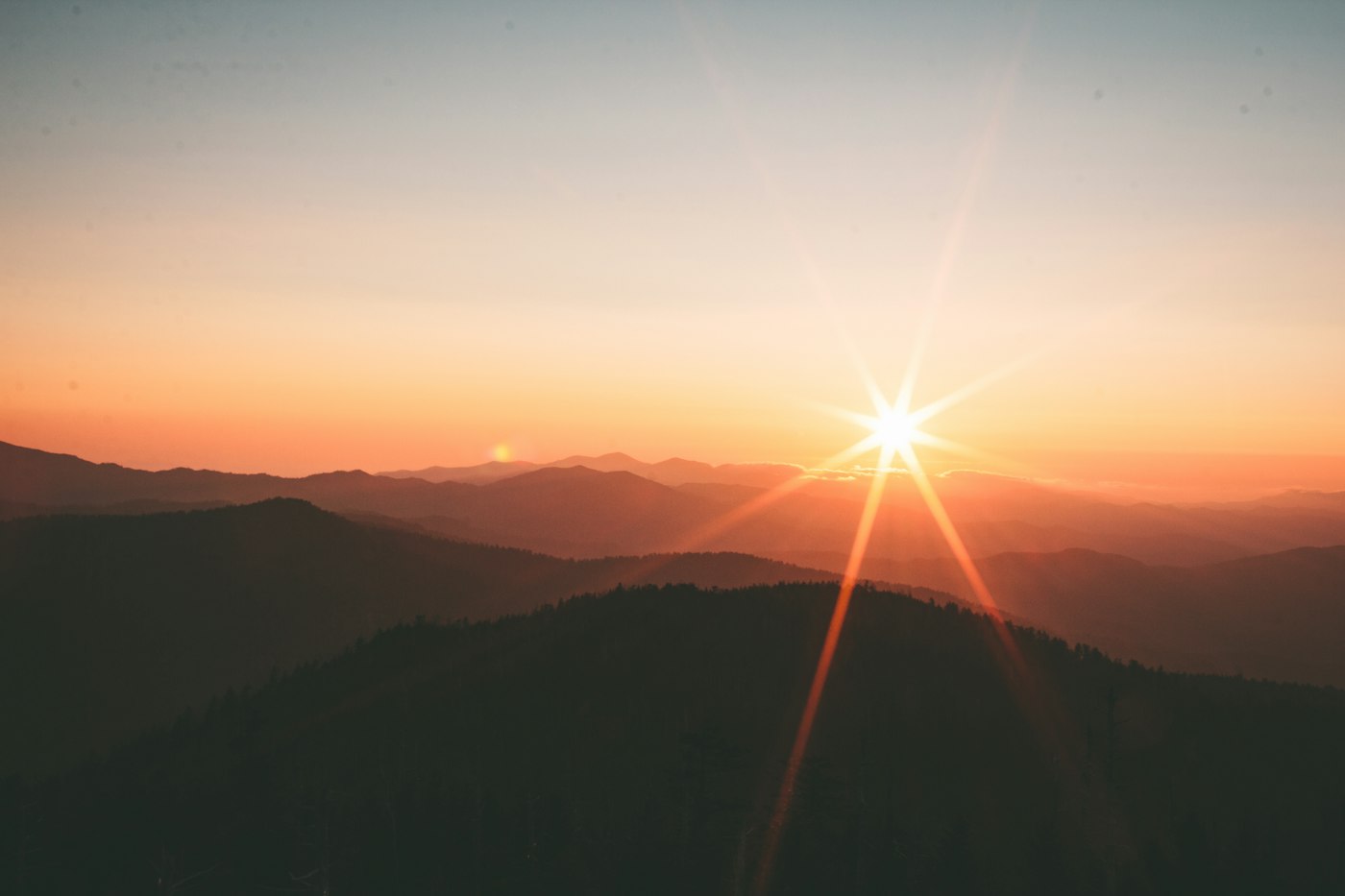
Thunder Bay, on the north shore of Lake Superior, is the only city of any size in northwestern Ontario. About 120,000 people live there. It is a long drive from anywhere — 1,400 km from Toronto, 700 km from Winnipeg — and that remoteness is part of the point. The Sleeping Giant peninsula, visible across the bay from downtown, is one of the most photographed natural features in the province; the trail to its top is a 22 km out-and-back that takes a full day. The city has a large Finnish heritage (Finnish-language signage still appears on some Bay Street businesses), a major port handling grain and potash bound for the Atlantic, and a substantial Indigenous population that includes the largest urban Anishinaabe community in Canada.
Sudbury, 1,000 kilometres east, is an old nickel-mining city that spent the 1970s reclaiming the moonscape the smelters had made; it is now surprisingly green, with Science North (the country's second-largest science centre, set partly inside an old mine), a big Franco-Ontarian population, and Laurentian University, currently rebuilding after a 2021 financial restructuring. Sault Ste. Marie, halfway between Thunder Bay and Sudbury along the lake, anchors the locks on the St. Marys River and is home to a steel mill, a casino, and the start of the Algoma Central Railway tour through the Agawa Canyon.
Post-secondary education in northern Ontario
Lakehead University, in Thunder Bay, is the largest university in northwestern Ontario, with around 9,500 students; its forestry, engineering and natural-resources programs are the regional strengths. Confederation College, also in Thunder Bay, is the polytechnic. In Sudbury, Laurentian University has rebuilt enrolment back to around 7,000 after the 2021 restructuring; the Northern Ontario School of Medicine, jointly run with Lakehead, is the country's first medical school built specifically to train doctors who will practice in northern, rural and Indigenous communities.
Housing & cost of living in the North
Housing is dramatically cheaper than southern Ontario. In Thunder Bay a one-bedroom apartment rents for roughly CAD $1,100–$1,400, and a detached home costs around $360,000. Sudbury is similar. The cost-of-living advantage is partly offset by higher heating costs (winters are noticeably colder than Toronto's) and higher driving costs — the region's economy assumes everyone has a car. Food prices, particularly fresh produce, are higher than in southern Ontario because of the trucking distance.
Cultural scene, food & tourist attractions
The Terry Fox Memorial, on the Trans-Canada Highway just east of Thunder Bay, marks the spot where the Marathon of Hope ended in 1980. Fort William Historical Park, on the city's west side, is one of the most ambitious living-history reconstructions in Canada — a re-creation of the early 19th-century inland headquarters of the North West Company. Eat the Persian (a local cinnamon-and-pink-icing pastry, found nowhere else) at the Persian Man, and the Finnish pancakes at the Hoito co-operative restaurant if it has reopened (it has been struggling and intermittently closed since 2020).
Sports & recreation
The North's sporting calendar is shaped by the seasons rather than by professional teams. Sleeping Giant in summer (hiking, swimming in 5°C water if you are brave), Loch Lomond Ski Area in winter, the Sibley Peninsula's interior canoe routes for the patient. Junior hockey — the Sudbury Wolves of the OHL, the Soo Greyhounds in Sault Ste. Marie — is the closest the region gets to professional sport.
The honest take
Northern Ontario is not a city break. It is for people who want to live near or visit large, raw landscapes. The drive from Thunder Bay to Sault Ste. Marie along Lake Superior is the most beautiful stretch of the Trans-Canada Highway east of the Rockies. The towns themselves can feel left behind by the rest of the province, and they often are; the medical school in Sudbury and the harbour in Thunder Bay are real bright spots, but the region's politics are dominated by a sense of being an afterthought to the south. Visit knowing what you are visiting.
Ontario FAQs
What is the legal drinking age in Ontario?
19. It is the same across every Ontario city. (Alberta, Manitoba and Quebec are 18; everywhere else in Canada is 19.) Alcohol used to be sold only through government-run LCBO stores and The Beer Store; since 2015 you can also buy it in grocery stores, and since 2024 in convenience stores. Restaurants can serve until 2 a.m.
What is HST and how much is it?
13 percent. It is the Harmonized Sales Tax, a combination of the 5 percent federal GST and the 8 percent Ontario provincial portion. It applies to almost everything you buy. Prices in Ontario are quoted before tax, unlike in some countries, so the sticker price is not what you pay at the till.
How do I get between Toronto and Ottawa?
Fastest and easiest is the VIA Rail train, which takes about 4 hours 20 minutes and runs eight or nine times a day. Driving is about 4.5 hours on Highway 401 and then 416 — straightforward but boring. Flying makes sense only if you are connecting elsewhere; Pearson-to-Ottawa is technically an hour in the air, but the total door-to-door time is roughly the same as the train.
Is Ontario safe for solo travellers?
Yes. Toronto, Ottawa, Kingston and Niagara are all comfortably walkable for a solo traveller at night. The usual big-city caution applies — do not leave a bag unattended, avoid empty subway cars late at night — but violent crime against visitors is rare. Hitchhiking is not recommended anywhere in northern Ontario; distances are long and assistance is slow to arrive.
Is Niagara Falls worth a full day?
A full day is enough. Two days is too much unless you are also doing Niagara-on-the-Lake and a winery tour. An early start from Toronto (catch the 8 a.m. train), two hours at the falls, an afternoon on the boat and the Journey Behind the Falls tunnels, and you are home for dinner.
What is cottage country?
It is the collection of lake districts north of Toronto — Muskoka and the Kawarthas are the best known — where Ontarians have built second homes for more than a century. From the Friday afternoon of Victoria Day (the last Monday before May 25) to the Thanksgiving Monday in October, the 400-series highways north of Toronto are clogged with cottage traffic. Renting a cottage for a week in July will run you anywhere from CAD $2,500 to $12,000 depending on size and lake.
Can I drive from Toronto to Hudson Bay?
No, at least not on public roads. The northernmost Ontario community with a road connection is Pickle Lake, 530 kilometres north of Thunder Bay. Further north, communities like Fort Severn on Hudson Bay are reachable only by air, or by winter ice road when it is cold enough.
Where should I move to in Ontario as a newcomer?
It depends on your job. Toronto remains the largest landing pad for newcomers because of job density and existing diaspora communities, but housing costs are the highest in the country. Ottawa is the best value for federal-sector or biotech work. The Waterloo region is the best fit for tech, Hamilton for healthcare, London for insurance and academia, Windsor for skilled-trades manufacturing. Outside the big cities, Kingston and the Niagara region attract a steady flow of remote-work relocators.
Which Ontario university should I apply to?
For computer science and engineering, Waterloo. For medicine, Toronto, McMaster, Western, Queen's or NOSM (Sudbury/Thunder Bay) depending on your match. For business, Ivey at Western or Rotman at Toronto for case-method MBA-style programs; Smith at Queen's, Schulich at York, DeGroote at McMaster, Goodman at Brock and Telfer at Ottawa fill out the next tier. For law, Toronto, Osgoode (York), Western, Queen's, Ottawa and Windsor are the main faculties.
Is Ontario a good place to retire?
For Canadians from elsewhere, increasingly yes — Niagara, Prince Edward County, the Kawarthas and Kingston have all attracted significant retiree migration in the 2020s. Ontario's healthcare system, while strained, has the deepest specialist coverage in the country. The main negatives are property taxes (higher than Alberta or BC) and the cold winters; the main positives are family proximity for retirees with children in the GTA, year-round culture, and a long warm-weather season by Canadian standards.