
Build a regional route
Try linking nearby states: New York to Pennsylvania, Colorado to Utah, or Louisiana to Mississippi and Alabama.
Explore America
The United States is often described as one of the world’s most influential countries because it combines scale, opportunity, invention, natural beauty, cultural influence and regional variety in a way few countries can match. This page explains that idea as a travel and learning guide, not as a list of links.

Clickable USA map
Tap any state to open its full America Explorer state guide with travel ideas, cities, cuisine, culture, five-day itinerary links and practical planning details.
Try linking nearby states: New York to Pennsylvania, Colorado to Utah, or Louisiana to Mississippi and Alabama.
Use state pages with city-price tools to compare travel costs, school areas, transportation and pace.
Every state guide connects to local cuisine and beverage history so the trip has flavor, not just stops.
The USA is not one experience. It is fifty states, thousands of cities and towns, enormous wilderness areas, world-famous universities, global companies, creative industries, immigrant neighborhoods, Indigenous nations, farms, ports, deserts, forests, mountains, beaches and small communities that all tell different parts of the national story. A visitor can move from Broadway to the Grand Canyon, from jazz clubs to national parks, from New England villages to Pacific surf towns, and still be inside one country.
That scale is one reason people call America exceptional. It offers choices: high-energy cities or quiet rural roads, warm beaches or snowy peaks, luxury hotels or low-cost road trips, global museums or free public parks. The same site can serve a first-time traveler, a student, a teacher, a family, a road-tripper, a newcomer or someone comparing where to live.
What makes it powerful
These strengths are why the USA remains one of the world’s most influential places to visit, study and understand.
Few countries have this mix of canyons, glaciers, volcanoes, beaches, deserts, forests, lakes, prairies, mountains and protected parks.
American music, film, television, sports, technology, literature and food shape global culture every day.
The national story is tied to ambition: building businesses, studying at major universities, creating art, moving for work and starting over.
The Northeast, South, Midwest, Southwest and West feel different in food, speech, landscapes, cities, history and daily life.
From aviation and medicine to software, entertainment and space exploration, the USA continues to produce ideas that travel worldwide.
The road-trip culture, park system, domestic flight network and huge variety of towns make independent exploration part of the national character.
America’s strength is not perfection; it is possibility. It is a place of big arguments, big landscapes, big inventions, big contradictions and big dreams. That makes it one of the richest countries in the world to learn about, because every state adds a new chapter.
America Explorer is built to help readers understand that scale with practical routes, state guides, city guides, culture pages, food pages, classroom tools and built-in itineraries.

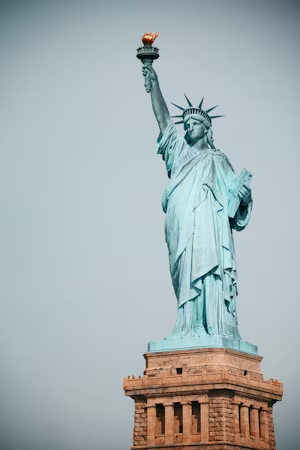
National icons carry stories about immigration, democracy, civic ideals and public memory.
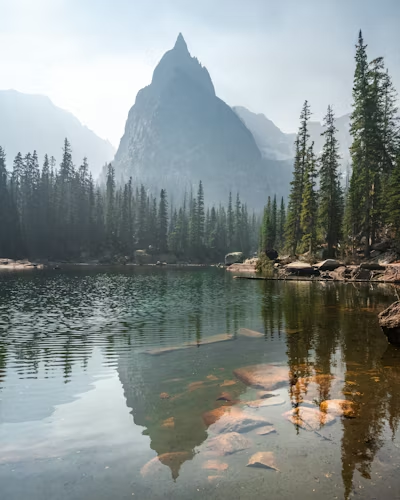
National parks and landscapes turn geography into a major part of American identity.

American cities connect finance, media, food, fashion, immigration, education and art.

Food traditions make each region easier to understand and more enjoyable to visit.
Explore deeper
The strongest USA trips are built around contrast: a major gateway city, a historic district, a food stop, a landscape anchor and at least one slower local day. This page helps visitors move beyond a simple list of places and understand how regions connect, why distances matter and what kind of experience each area delivers.
Use the guide as a first filter. The Northeast works well for history, museums and train-friendly cities. The Southeast is ideal for music, beaches, foodways and civil-rights history. The Midwest is strong for lakefront cities, architecture, sports and heartland culture. The Southwest is built for desert scenery, Native nations, canyon country and road trips. The West delivers national parks, Pacific cities, mountain towns and coastline.
Start with one region and two major bases instead of trying to cross the country too quickly.
Mix one famous attraction with one neighborhood, market, local meal or scenic stop each day.
Compare how geography shaped settlement, transport, food, music and regional identity.
Useful details
This page is built to help visitors make a real choice, not just click through a directory. Read it as a planning page: identify the strongest places, compare the practical details, then connect the page to states, cities, food, culture and itinerary tools.
Choose the best season, build around one or two anchor experiences, and leave space for meals, walks, local stops and slower moments that make a trip feel personal.
Look for the regional story behind the place: geography, migration, industry, music, food, sport, architecture, politics or natural landscape. That context makes each stop more memorable.
Use the internal links to move from broad overview to detailed state pages, city guides, culture features, food routes and five-day itineraries with cost guidance.
Tip: build trips around contrast — one famous landmark, one local neighbourhood, one regional meal and one story worth remembering.